Nature Play and Our Proprioceptive System
Climbing, carrying, pushing, pulling, gardening, and loose-parts play all give children valuable information about their bodies and how they move through the world.
Proprioception is our body-awareness sense.
Our proprioceptive system helps us understand where our bodies are in relation to the world around us and where our limbs are in relation to the rest of our bodies.
It also helps us judge how much force or pressure an activity requires — whether that means holding a crayon without snapping it, carrying something heavy, or knowing how hard to push against an object.
Close your eyes and touch your nose with one finger. That is your proprioceptive system quietly doing its job.
Big Body Movement Feeds the Proprioceptive System
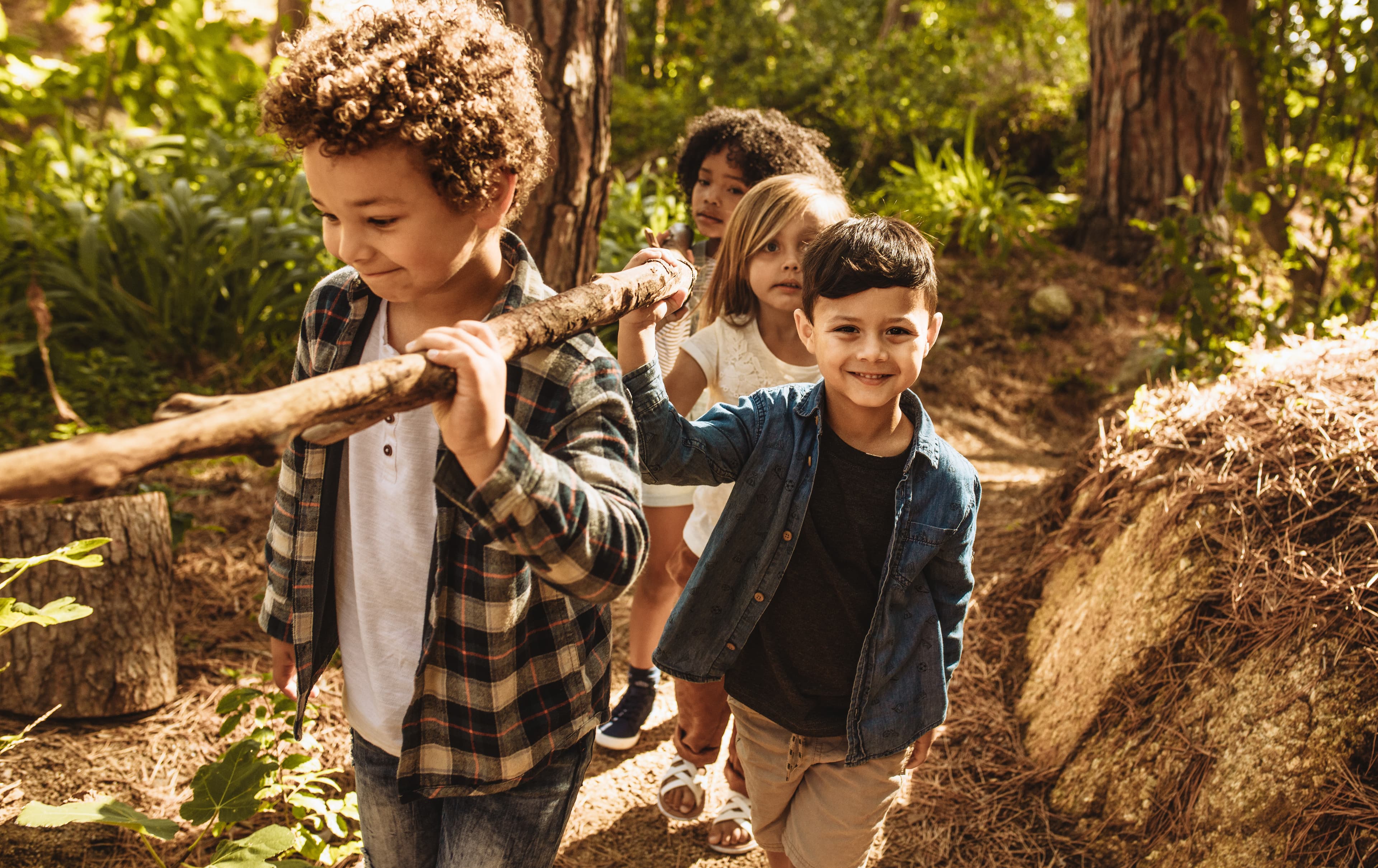
Children’s proprioceptive systems thrive on movement-based play. Climbing and jumping give muscles and joints plenty of input while also supporting balance, coordination, and body confidence.
Logs, boulders, uneven surfaces, and other natural features can create exactly the kind of whole-body challenge that gives children rich proprioceptive feedback.
Gardening Is Full of Proprioceptive Input
Gardening asks children to use their bodies in a huge variety of ways. Planting seeds, digging with a hand trowel, raking, watering, transplanting seedlings, pruning, and harvesting all involve combinations of force, coordination, movement, and body awareness.
Even ordinary garden tools can make the experience richer because children have to adjust how much pressure and strength they use depending on the task.
Pushing, Pulling & Carrying
Pushing a child-sized wheelbarrow or pulling a wagon combines balance, strength, resistance, and movement.
You can also vary the intensity naturally. An empty wagon offers less resistance than one filled with loose parts or friends. A partly filled watering can is easier to carry than a full one. Those simple differences let children find the amount of sensory input that feels right for their bodies.
Sensory play works best when children have room to find the amount and intensity of input that feels right for them.
Loose Parts Add Even More Possibility
Branches, stones, pinecones, seed pods, and other natural loose parts invite children to lift, carry, stack, drag, sort, build, balance, and manipulate objects in countless ways.
Those activities combine proprioceptive input with fine-motor skills, balance, coordination, imagination, and problem-solving.
Sensory Plants Can Support Body Awareness Too
Plants can become part of proprioceptive play in surprisingly physical ways. Ornamental grasses and seed heads can become loose parts. Evergreen cones can be collected and built with. Edible plants invite children to squat, bend, reach, move branches, pick, carry, and coordinate their hands and eyes.
Even something as simple as searching blueberry bushes for ripe berries asks the body to move through space, change position, and adjust pressure and coordination.
Think About the Whole Play Space
A proprioceptive-rich play environment does not need specialized equipment everywhere. It needs opportunities for children to use their muscles, joints, hands, balance, and strength in different ways.
Uneven paths, logs, gardens, loose materials, watering cans, wagons, climbing opportunities, and plants can all become part of a space that gives children meaningful whole-body sensory input.
Nature Play for the 7 Senses
Explore more ways to create sensory-rich natural play and learning spaces for children through Jena’s guide to the seven sensory systems.
Explore the Guide >